Processions
-
PollinicaPalm Sunday11:30C/ Carmen, 44
Add to calendar

-
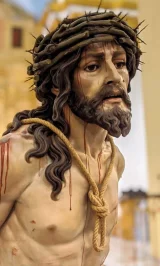
Cristo UltrajadoHoly Tuesday19:30Iglesia de Santa María del Reposo
Add to calendar

-
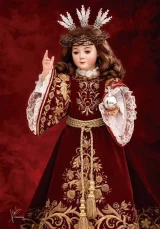
Dulce NombreHoly Wednesday19:00C/ San Sebastián, 33
Add to calendar
-
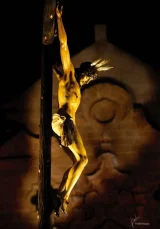
Vera+CruzMaundy Thursday21:30Iglesia de la Santa Vera+Cruz
Add to calendar
-
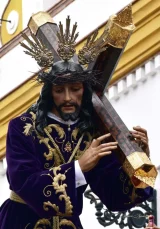
Jesús NazarenoGood Friday morning11:00Avda. Puerta de Teba, 29
Add to calendar
-
Santo EntierroGood Friday night21:30C/ San Sebastián, 16
Add to calendar
-
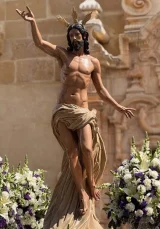
Cristo ResucitadoEaster Sunday11:00Iglesia de Santa María del Reposo
Add to calendar
Festival of National Tourist Interest of Andalusia 21–28 March 2027
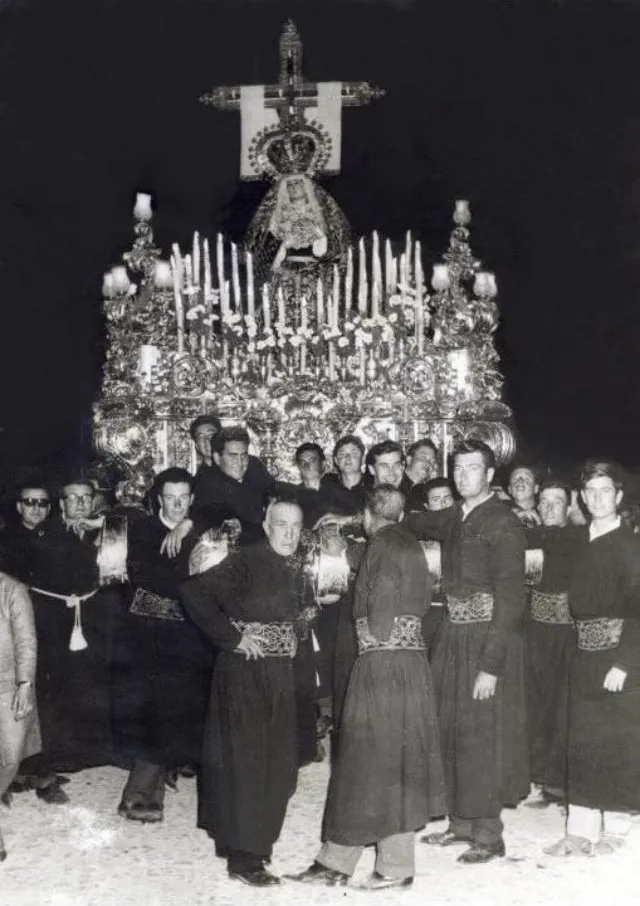
Processions in Campillos have been documented since the 16th century. Today, five brotherhoods and one parish group carry eleven tronos and one paso (processional floats) through its streets, most of them Baroque works showing a Sevillian influence. This heritage, shared by the whole town, earned Semana Santa in Campillos this distinction in 2001 and now supports its bid for recognition as a Festival of National Tourist Interest.
Experience Semana Santa in Campillos
The pasos (processional floats) of Holy Week and the people of Campillos in their processions.
This video is the visual version of the description that follows the player.
Video description
- 0:00 At night, children and young people in white robes carry lit candles.
- 0:10 Against the light, the silhouette of an image of Christ with one arm raised.
- 0:20 Details of the procession: a lit wax lantern, an acolyte carrying the crown of thorns on a purple cushion, and band musicians with embroidered pennants.
- 0:35 A crucified Christ between lit lanterns, in the darkness.
- 0:40 Palm Sunday: Jesus riding the donkey among palms, beside the sign of the Hermandad de la Pollinica.
- 0:45 A silver palio (canopy) with the Virgin, among candles and flowers, makes its way along a narrow street.
- 0:50 In broad daylight, an image of Christ carrying the cross passes beneath the balconies, and the Risen Christ moves past a façade with the Holy Week poster.
- 1:00 The shadow of a crucified Christ on a wall, gold embroidery on purple velvet, and a recumbent Christ in his urn.
- 1:15 A crucified Christ lit up in the night.
- 1:20 A Dolorosa (sorrowful Virgin) in a green mantle, among candles and flowers; neighbours watch her from a balcony.
- 1:25 A trono (the processional float carried by bearers) moves between palm trees across a crowded square.
- 1:30 At night, two palios with their rows of candles lit.
- 1:40 The image of Christ carrying the cross passes the clock tower.
- 1:50 The silhouette of a trono at dusk, and a gilded trono lit up in a street at night.
- 2:00 A concert band leads the Risen Christ along a sunny, whitewashed street.
- 2:10 A band plays at night, with a crucified Christ in the background.
- 2:15 A seated Christ crowned with thorns, outlined against the sky with the full moon behind.
- 2:20 As the procession leaves the church: the leading cross, altar servers and a veteran in a green forage cap.
- 2:25 A palio inside the church, lit by candles.
- 2:30 A palio moves beneath balconies hung with drapes.
- 2:35 The bearers (hombres de trono) up close: young people in white robes, men in purple robes and women under the carrying poles, straining with the effort.
- 2:50 The seated Christ beneath the moon, and the image of Christ carrying the cross seen through an arch.
- 3:00 A concert band at night, and a main street packed with people, with a trono in the distance.
- 3:10 The image of Christ carrying the cross against the light, with the sun shining through the cross.
- 3:20 At night, a gilded trono with a crucified Christ on the shoulders of its bearers.
- 3:30 Palm Sunday: nazarenos (robed penitents) with white capirotes (tall pointed hoods) and green capes, children with palms, and the tronos in a sunny street.
- 3:35 An image of Christ on his trono at night, beside a lit-up tower.
- 3:40 The Risen Christ in front of the stone façade of a church, among white flowers.
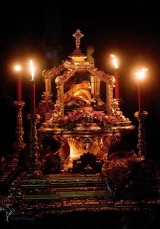
- 3:45 The recumbent Christ in his gilded urn, with red candles.
- 3:50 A man in the crowd, visibly moved.
- 3:55 Petals are thrown from a balcony as the Risen Christ passes the church among palm trees.
- 4:05 It closes with the coat of arms of Campillos and the title “Semana Santa Campillos”.
History of Semana Santa in Campillos
1492
Campillos was founded in 1492, and as early as the 16th century several documents record the existence of processions.
1593
Hermandad del Santo Cristo
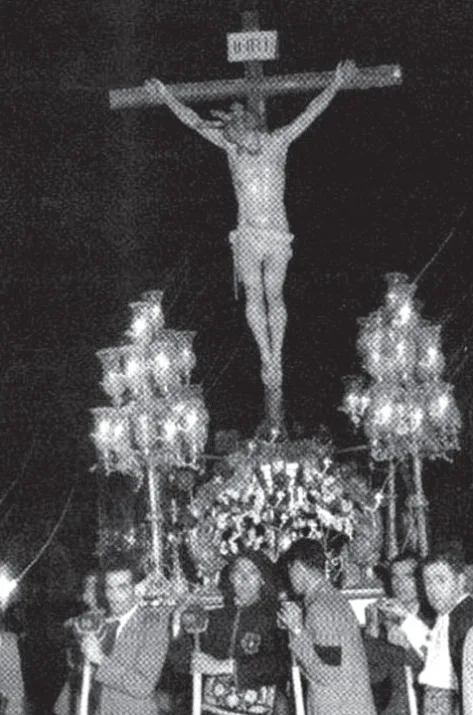
The oldest surviving document is a minute book of the Brotherhood of the Santo Cristo, dated 1593, which refers to the purchase of a plot from the Archdiocese of Seville, beside the parish church, to build its chapel.

The Santo Cristo de la Vera+Cruz, in a historic photograph. El Consiliario 2019, p. 63. 1648
Hermandad de Nuestra Señora de las Angustias
The oldest surviving minutes of the Hermandad del Santo Entierro date from 4 April 1648. They record that the Licenciado Benito Busan de Somoza, consultant to the Holy Office and Visitor General of the Archdiocese of Seville, came to the town of La Puebla de Campillos so that the brotherhood of “Nuestra Señora de las Angustias” could render him its accounts for the previous year (1647).
1675
Nuestra Señora de las Angustias y Santo Entierro de Cristo
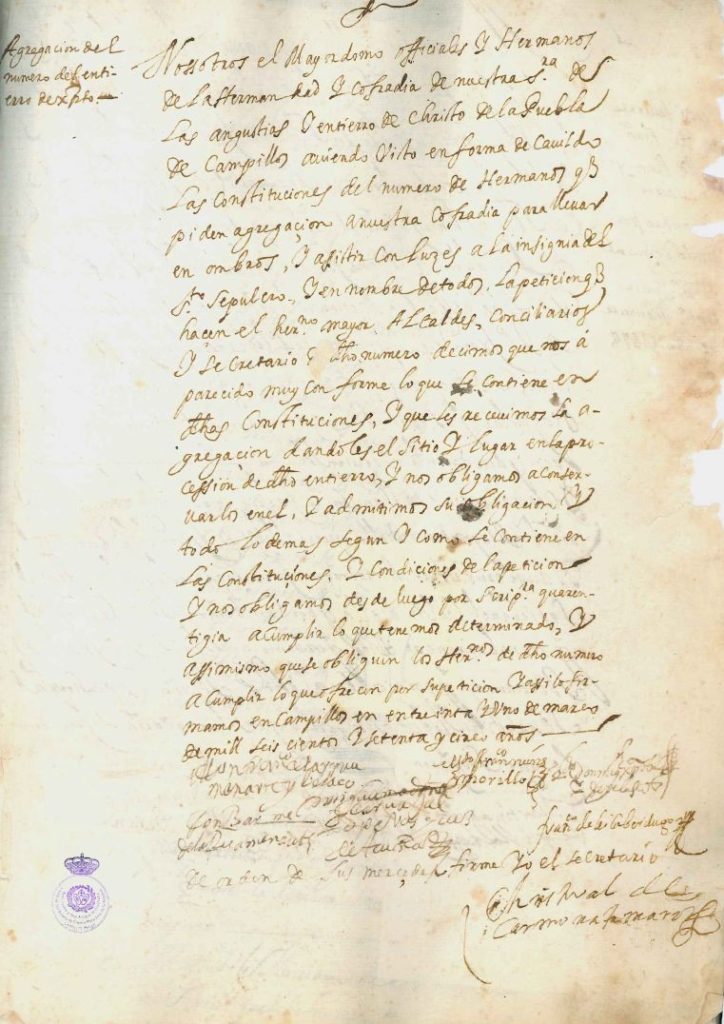
On 31 March 1675 the brotherhoods of Las Angustias and the Santo Entierro merged, taking the name Hermandad de Nuestra Señora de las Angustias y Santo Entierro de Cristo.

Minutes of the merger of the brotherhoods of Las Angustias and the Santo Entierro, 31 March 1675. 17th century
Hermandad de Jesús Nazareno
The Hermandad de Nuestro Padre Jesús Nazareno de la Misericordia must have been founded in the second half of the 17th century at the latest, once devotion to the figure of Jesus of Nazareth had taken firm root among the people of Campillos, a devotion that seems to have begun when María Gordilla and her descendants founded the chapel.
17th–18th centuries
Dulce Nombre de Jesús
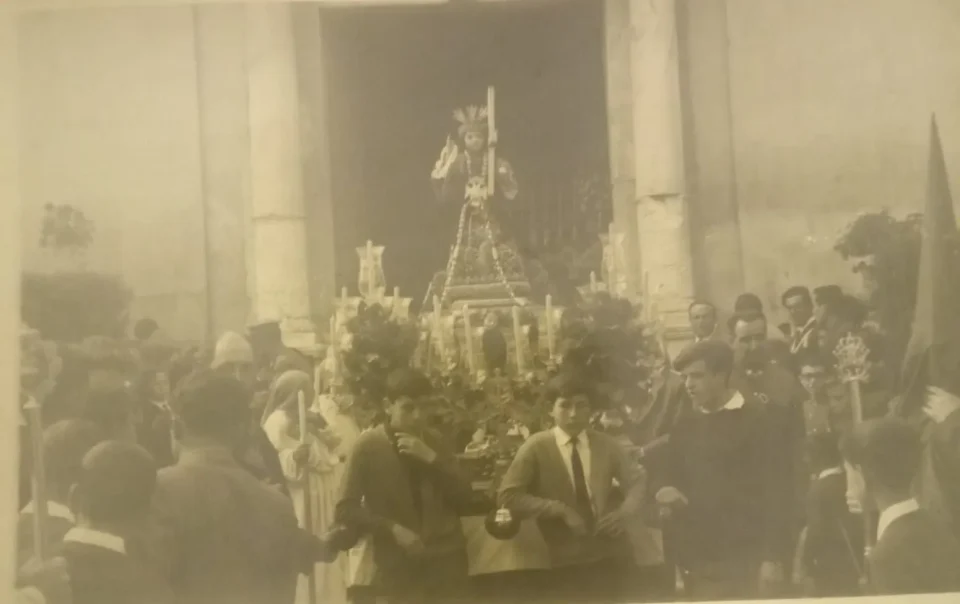
The image of the Dulce Nombre de Jesús is a fully carved figure of the Child Jesus foreshadowing his Passion. Its sculptor, apparently of the Granada school, is unknown. X-ray studies date it to the late 17th or early 18th century.

The Niño Chiquito leaving the church, in a historic photograph. 1937
Nuestro Padre Jesús Nazareno de la Misericordia
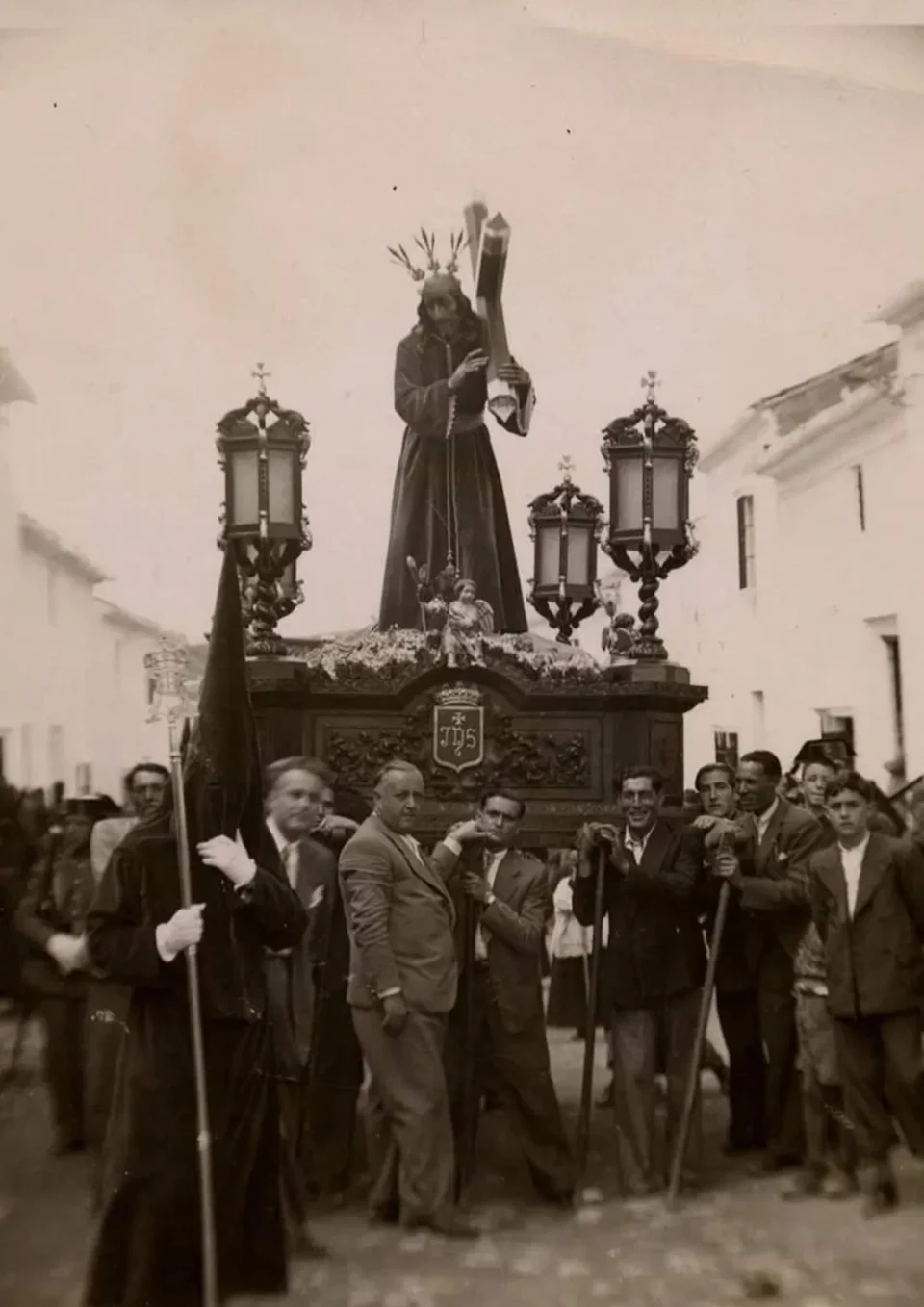
The sacred image of Nuestro Padre Jesús Nazareno de la Misericordia is the work of the sculptor José Navas Parejo (1937).
Nuestro Padre Jesús Nazareno in the streets of Campillos, in a historic photograph. 1937
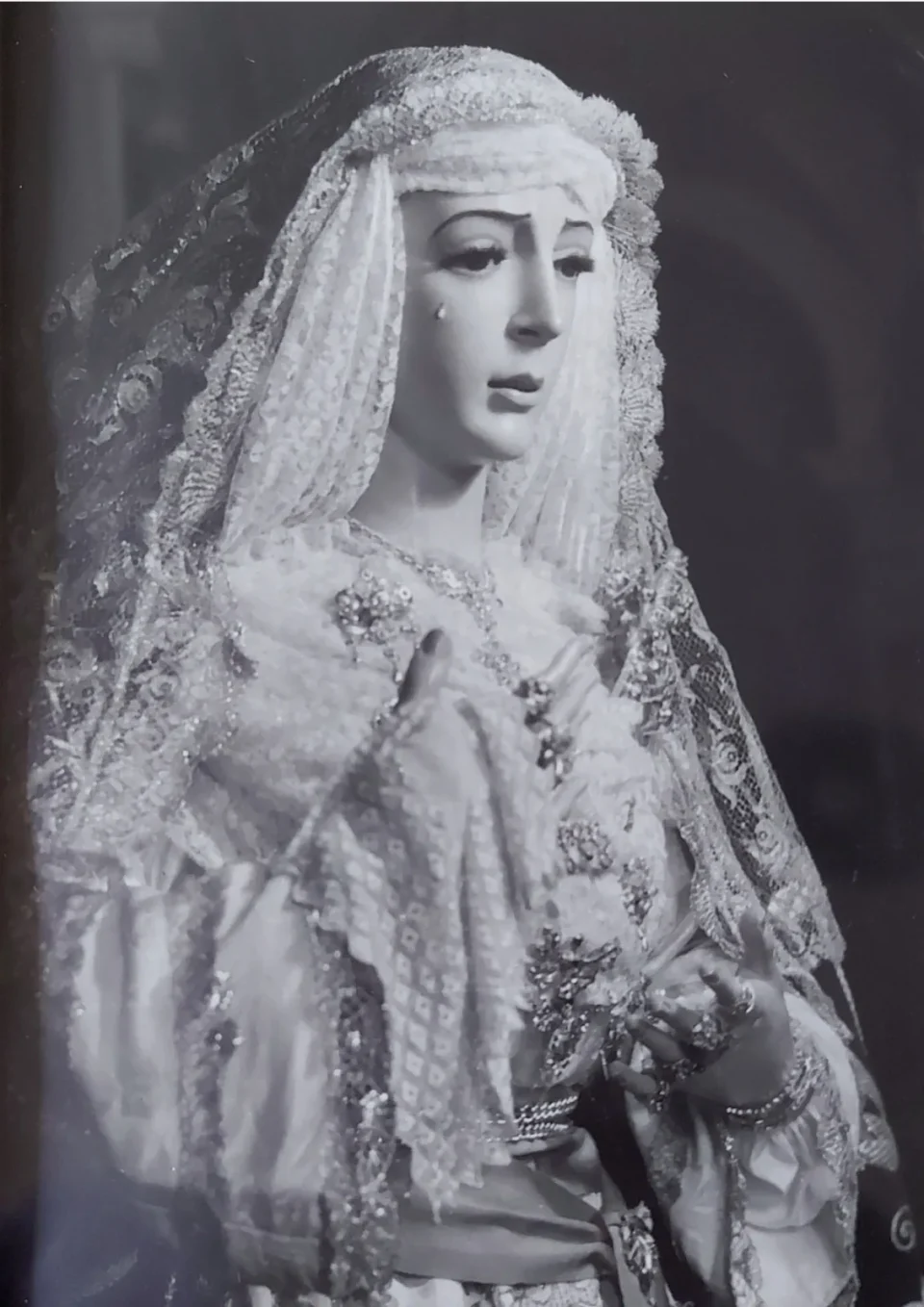
María Santísima de las Angustias
The sacred image of Nuestra Señora de las Angustias, like that of her Son in her arms, is the work of the Málaga imaginero José Navas Parejo, who settled in Granada, and dates from 1937.

María Santísima de las Angustias, in a historic photograph. 1939-1942
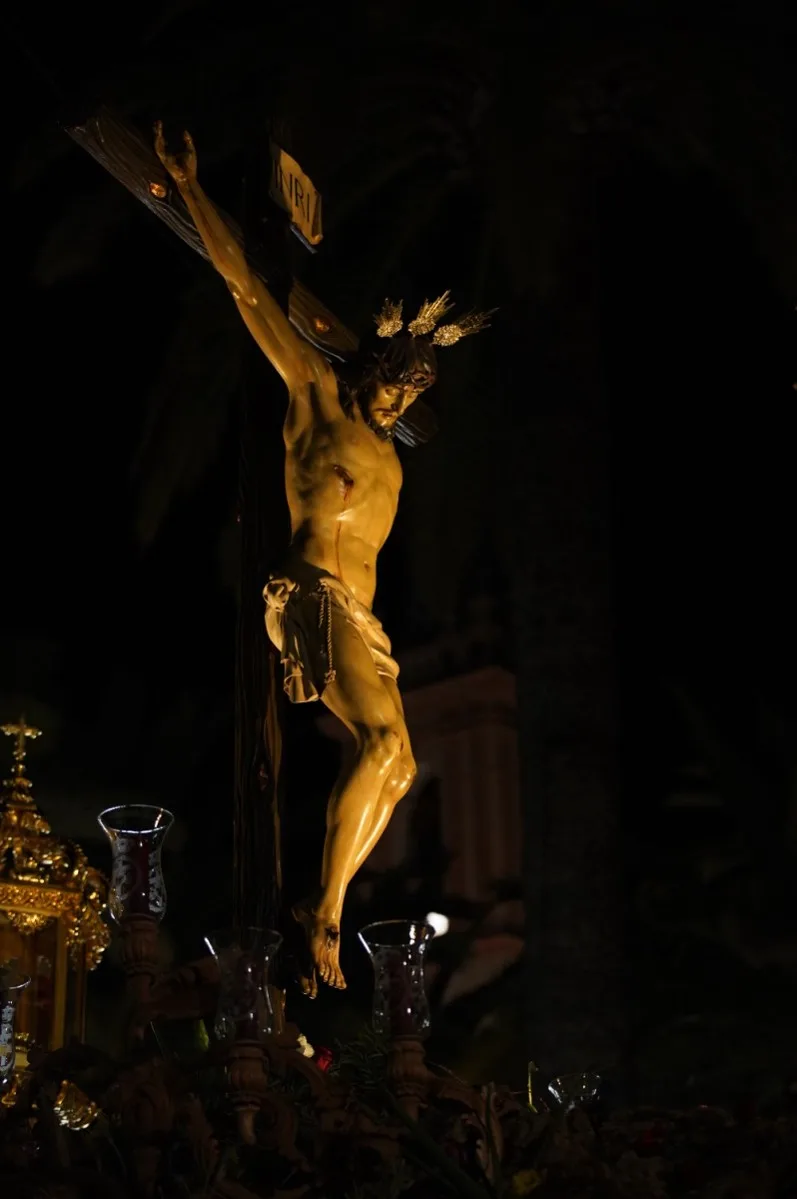
Santísimo Cristo de la Vera+Cruz
The sacred image of the Santísimo Cristo de la Vera+Cruz is the work of Antonio Torres Ruda, carved between 1939 and 1942.

Santísimo Cristo de la Vera+Cruz. 1941
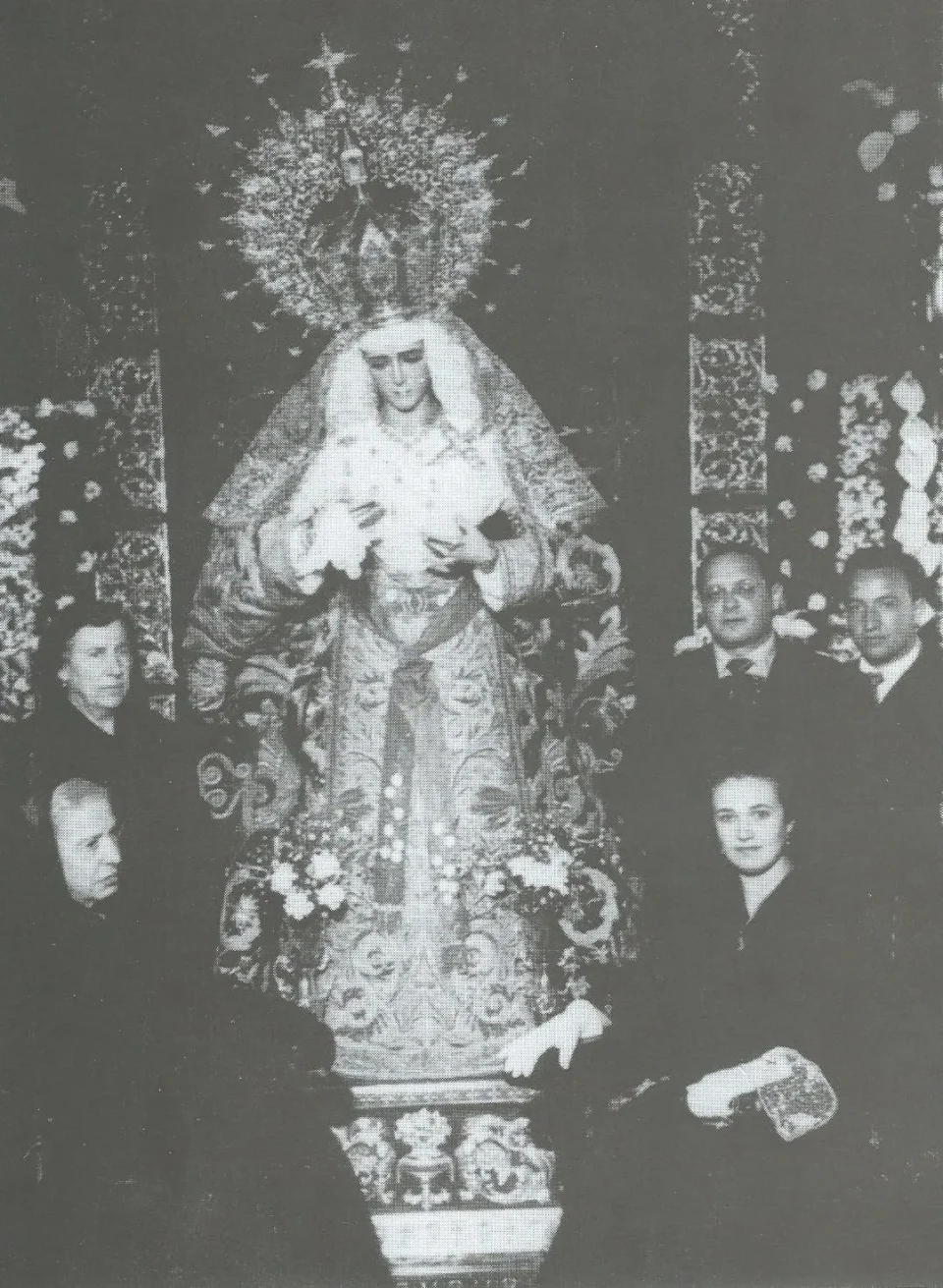
María Santísima de las Lágrimas
The sacred image of Nuestra Señora de las Lágrimas is the work of the distinguished Sevillian sculptor Antonio Castillo Lastrucci (1941).
María Santísima de las Lágrimas, in a historic photograph. El Consiliario 2021, p. 83. 1947
Pollinica
The Hermandad de Nuestro Padre Jesús a su Entrada en Jerusalén y María Santísima de Gracia y Esperanza is the youngest of the town’s brotherhoods, founded in 1947.

The Pollinica brotherhood, in a historic photograph. El Consiliario 2024, p. 43. 1947
María Santísima del Socorro
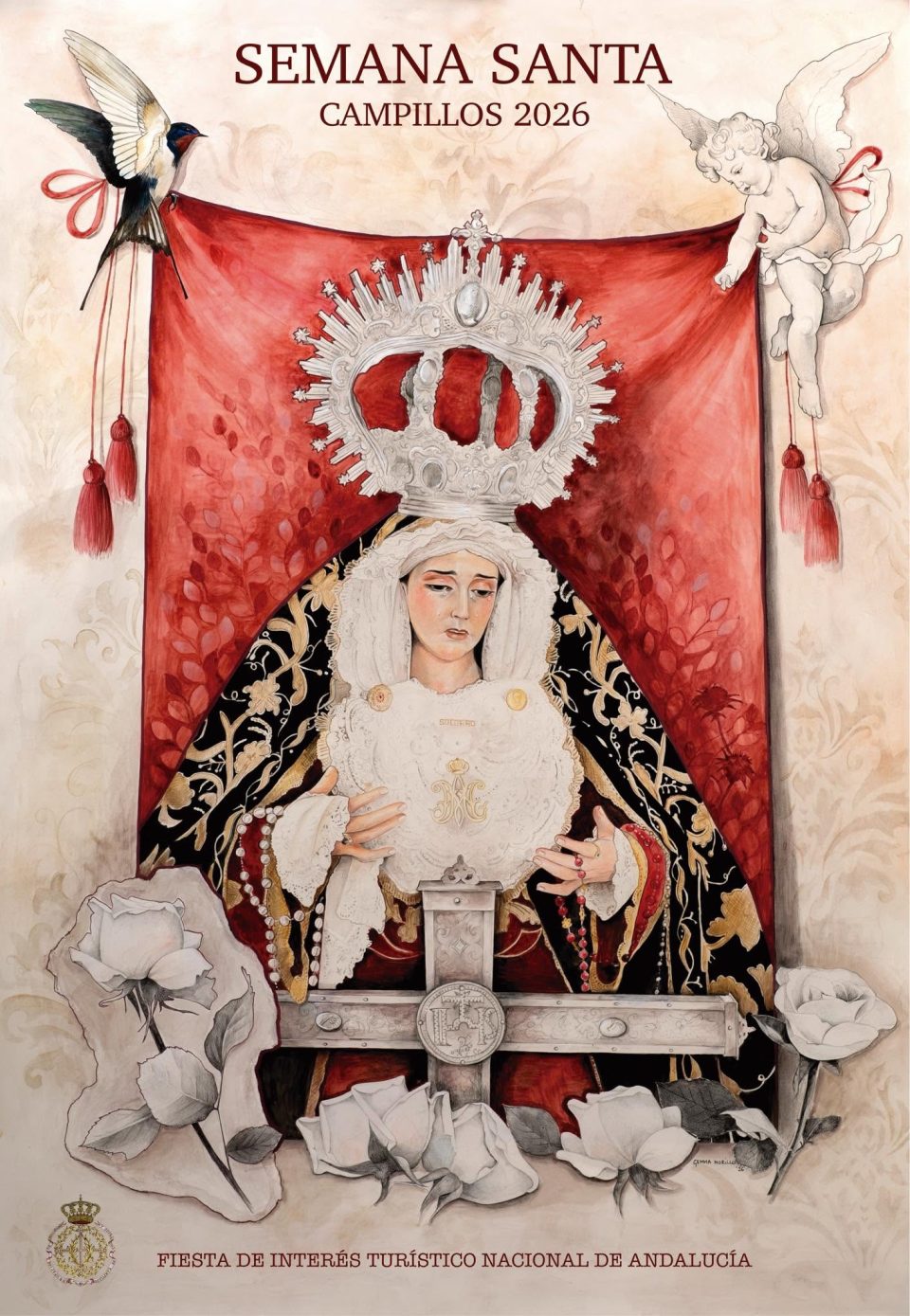
The present image of the Virgen del Socorro dates from 1947; its blessing and display for public worship and veneration were approved by the Cardinal Archbishop of Seville, Pedro Segura y Sáenz, on 15 April 1948.

María Santísima del Socorro. 1948
Santo Entierro de Cristo
This image was created by the Málaga sculptor Francisco Palma Burgos; it is signed on the left shoulder and dated in Madrid in 1948.

Old photograph. El Consiliario 2019, p. 93. 1952
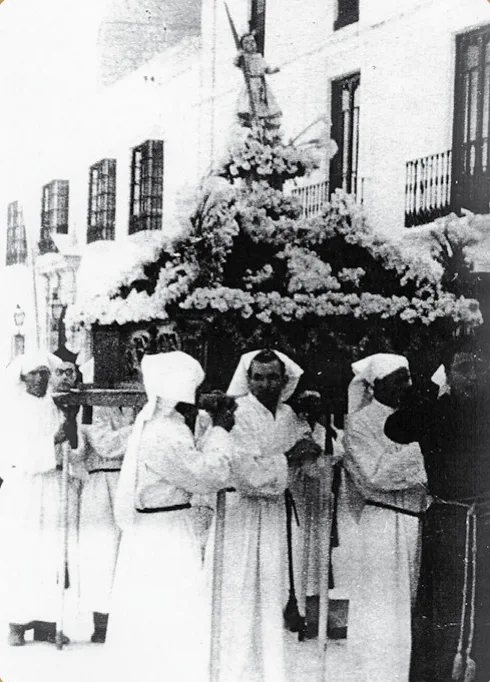
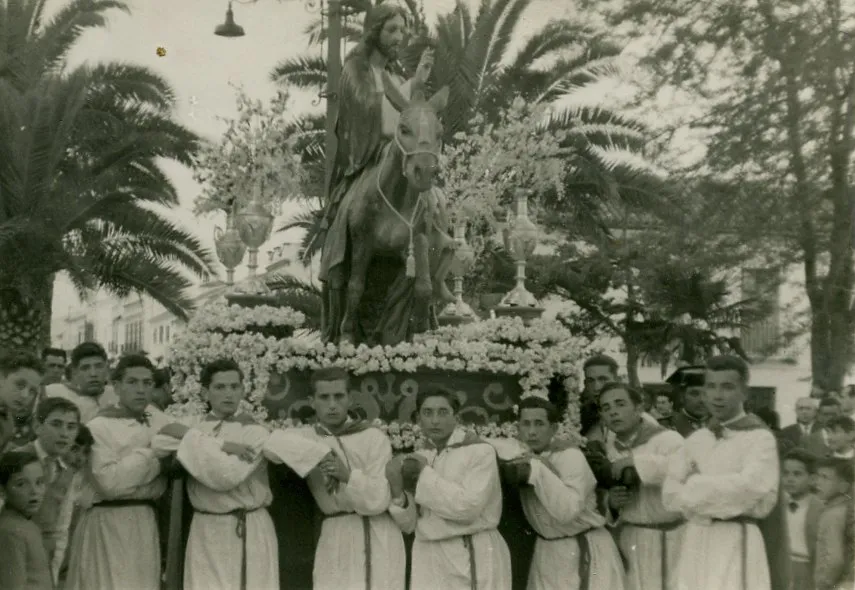
Nuestro Padre Jesús en su Entrada Triunfal en Jerusalén
A seated image, riding a donkey, made of wood-pulp paste and later painted in polychrome by the Olot workshops in 1952, donated by the Campillos Town Council.

The Pollinica carried by its bearers, in a historic photograph. Mid-20th century
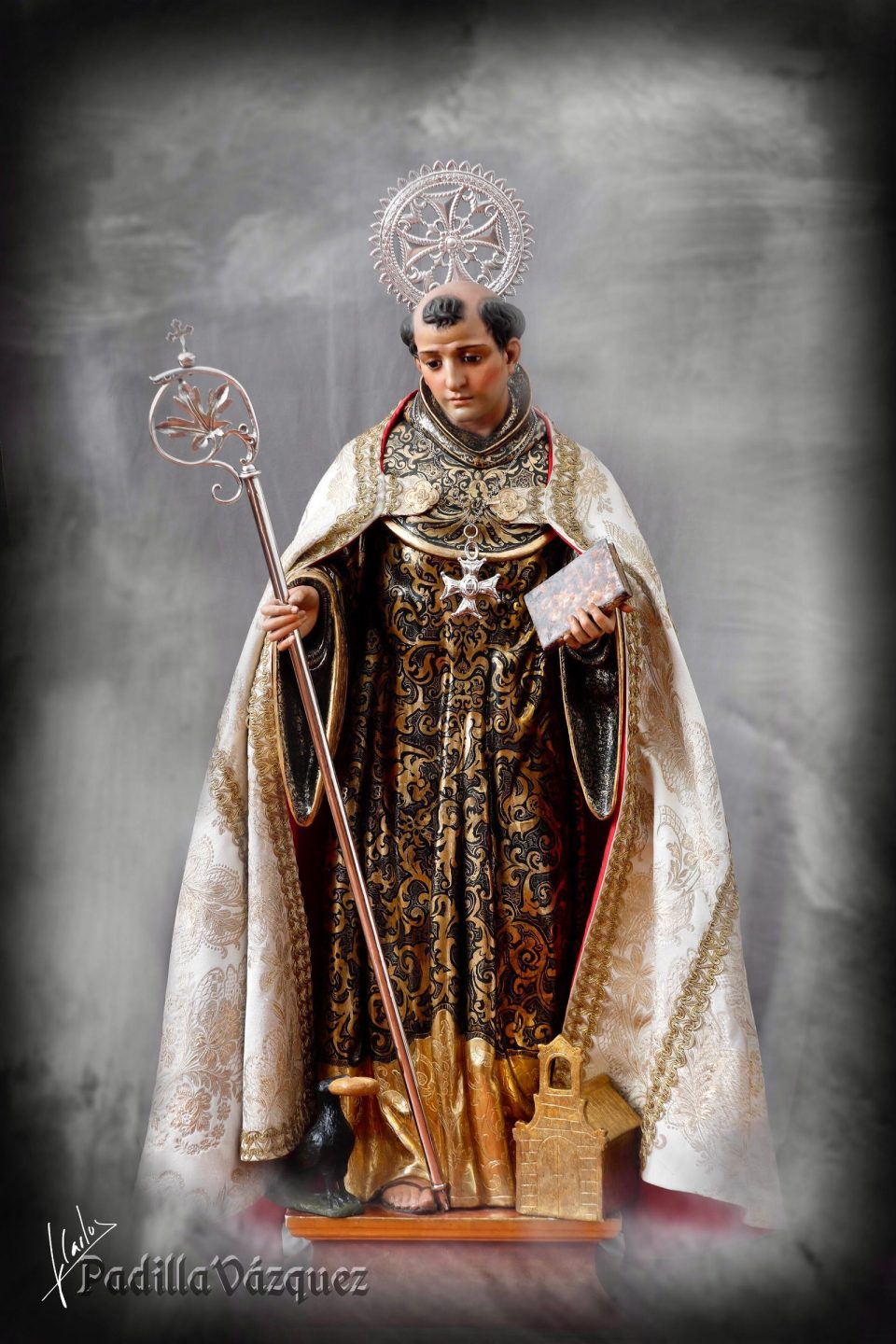
San Benito Abad
The image of San Benito Abad, patron saint of Campillos, is the work of the Granada sculptor and silversmith José Navas Parejo.

San Benito Abad. 1956-1957
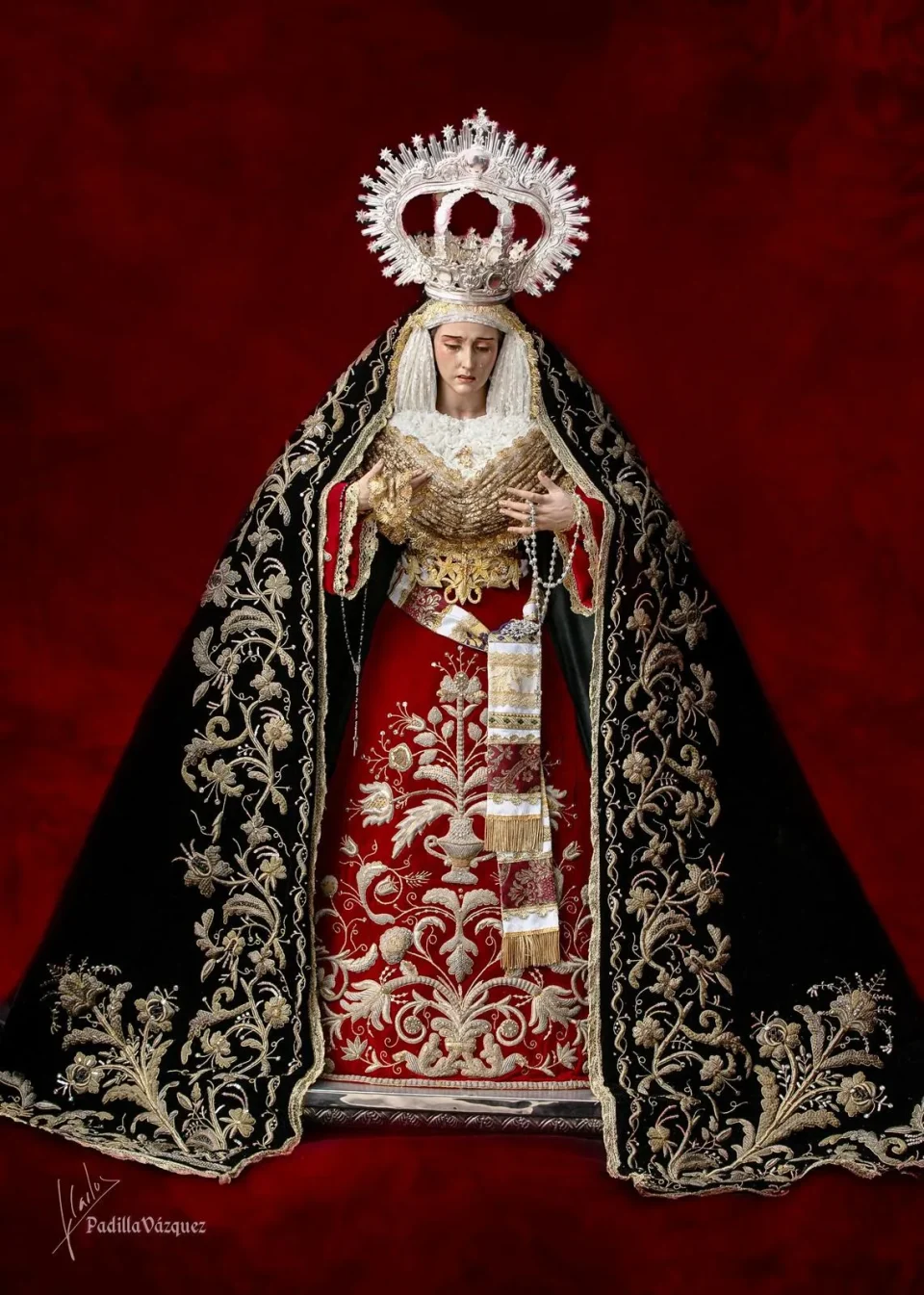
María Santísima de los Dolores
By Antonio Castillo Lastrucci. Made between 1956 and 1957.

María Santísima de los Dolores, in a historic photograph. 1957
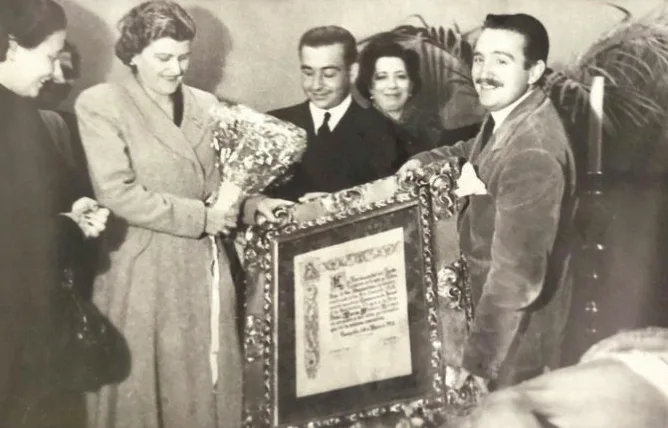
Association of Brotherhoods and Confraternities
On 20 March 1957 the Association of Brotherhoods and Confraternities of Campillos (Agrupación de Hermandades y Cofradías) was first established, with the aim of joining forces to improve and enhance the town’s Semana Santa.
1972
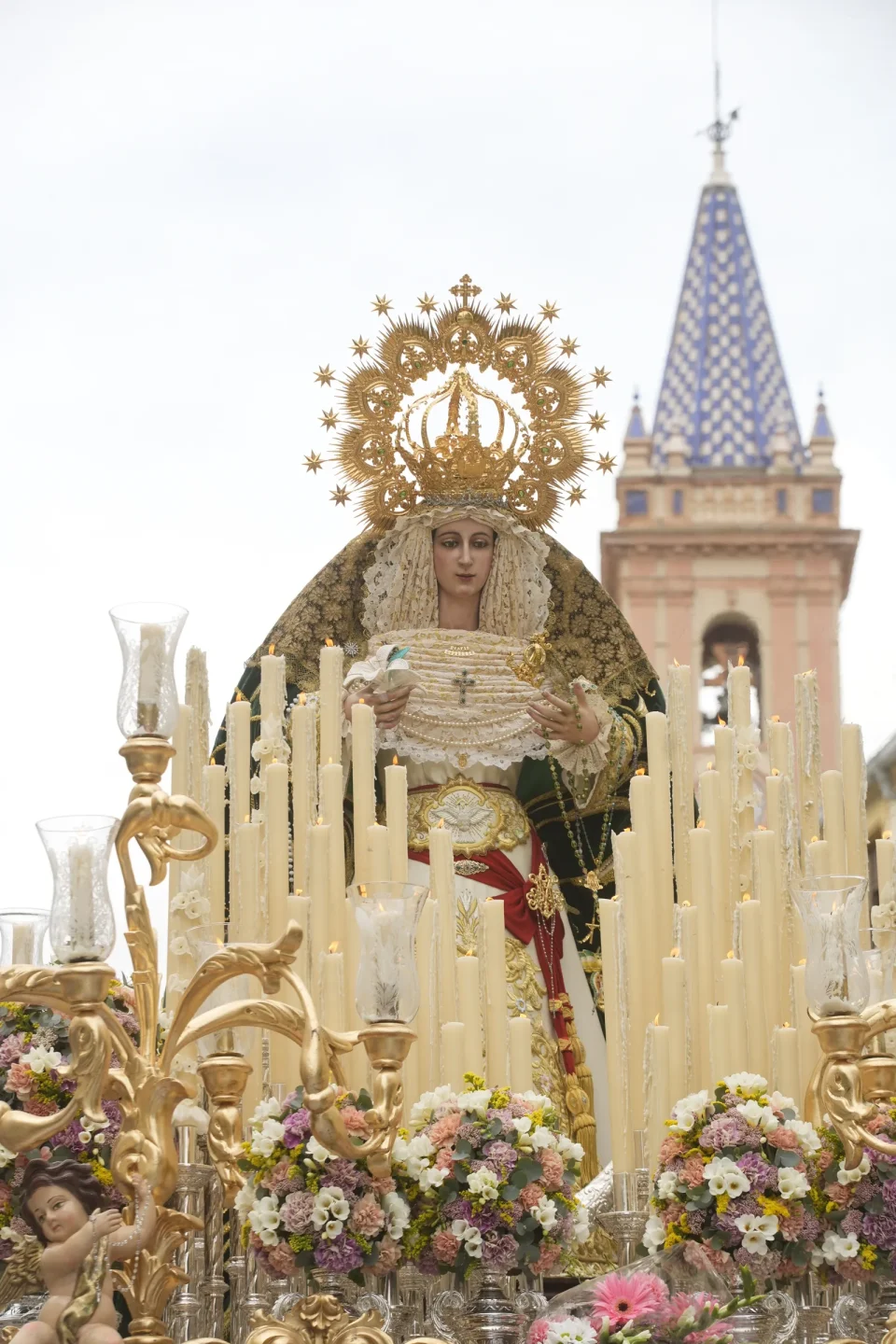
María Santísima de Gracia y Esperanza
An image of Our Lady of Sorrows of the “candelero” type (with a wooden framework beneath its clothing), made in Seville in 1972 by the Huelva-born artist Manuel Domínguez Rodríguez.
Gracia y Esperanza in front of the parish church tower. 1987
Association of Brotherhoods and Confraternities
The Association was reorganised in 1987 with one priority: to acquire an image of the Risen Christ to complete Campillos’s own Way of the Cross.
1988
Semana Santa Pregón
The Association has held the Semana Santa Pregón (ceremonial address) every year without interruption since 1988.

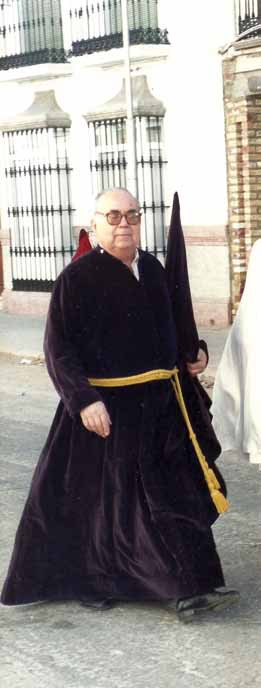
Alfonso Padilla Serra, the first official pregonero of Holy Week (1988). 1996
Campillos en su Pasión
The Association organised and took part in the exhibition “Campillos en su Pasión” (1996).
1997
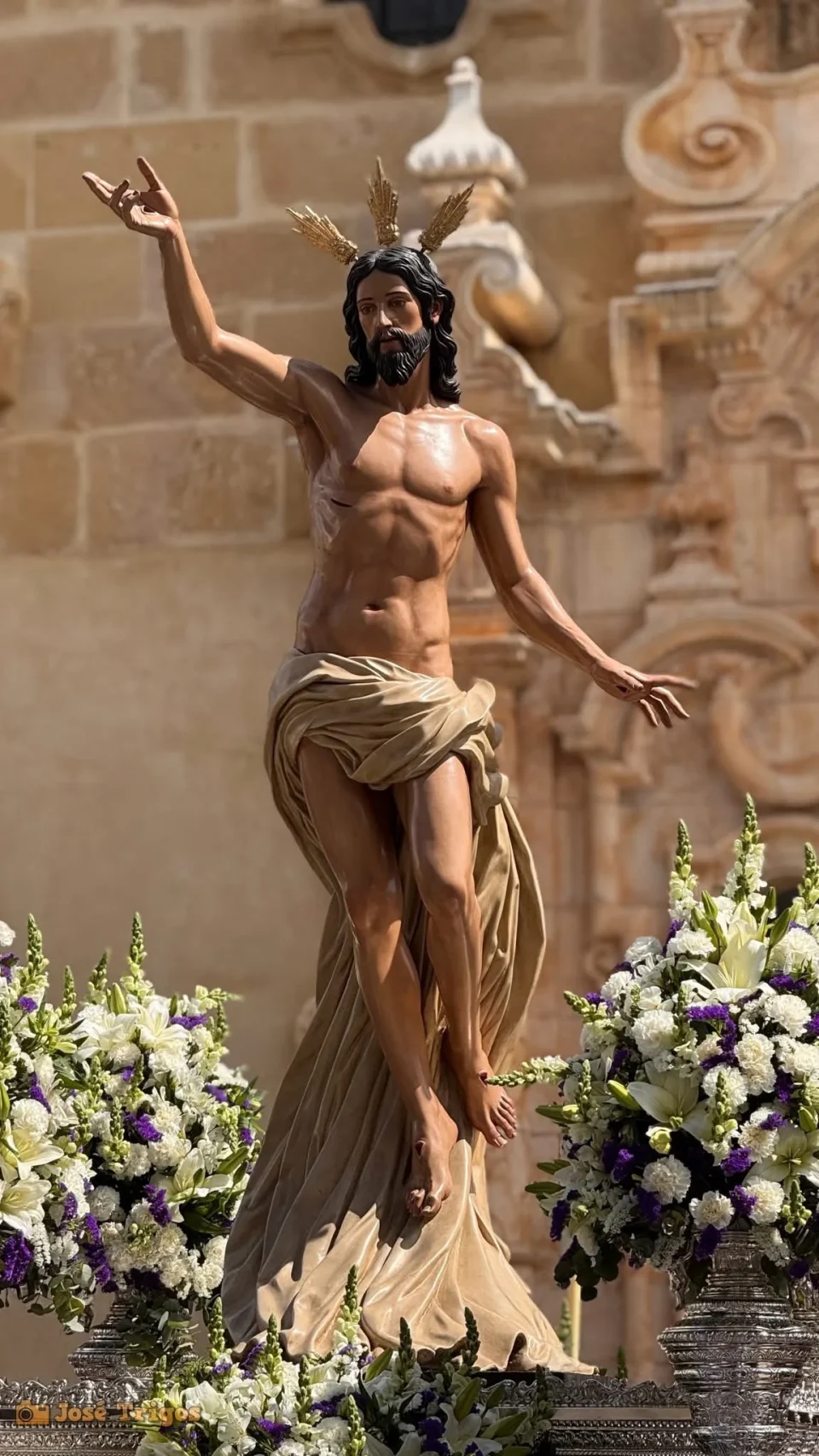
Santísimo Cristo Resucitado
Ten years later, in 1997, the work of Antonio M. Castillo Jarén was carried through the streets of Campillos for the first time.

Santísimo Cristo Resucitado. 2000
Jubilee Way of the Cross
A Jubilee Way of the Cross organised by the Association of Brotherhoods and Confraternities, in which all the images of Christ of the brotherhoods of Campillos took part to mark the Great Jubilee of the year 2000.

Logo of the Great Jubilee of the year 2000. 2001
Festival of National Tourist Interest of Andalusia
In 2001 Semana Santa in Campillos was declared a Festival of National Tourist Interest of Andalusia. It is now a candidate to be declared a Festival of National Tourist Interest by the Ministry of Tourism.
2013
“Mater fidelis” Magna Marian Procession
On 12 October 2013 the “Mater fidelis” Magna Marian procession was held to mark the Year of Faith: the images of the Virgin from all the brotherhoods and confraternities accompanied the Cristo Resucitado through the streets of Campillos.

Logo of the Year of Faith. 2016
Santísimo Cristo Ultrajado
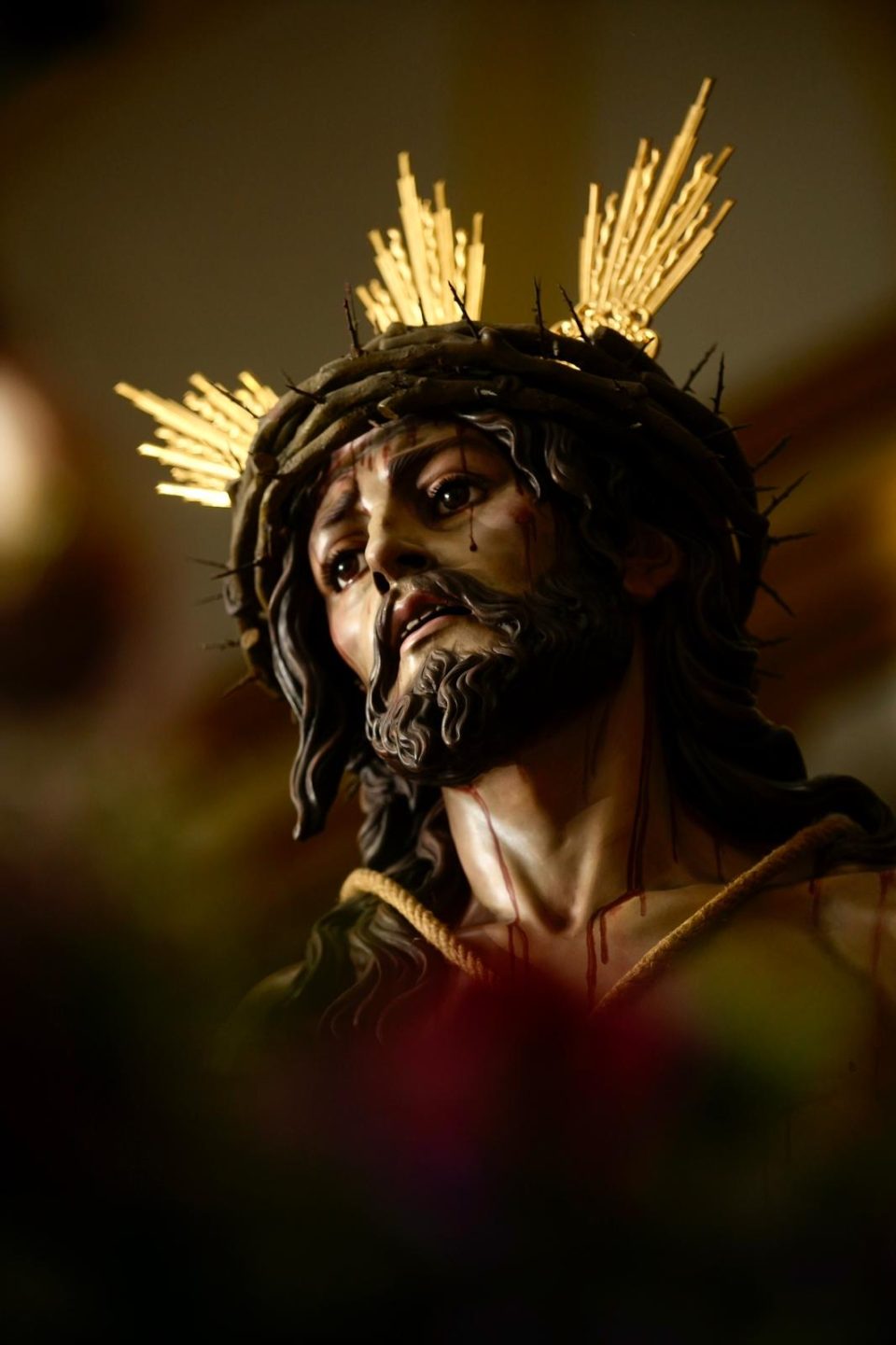
The sacred image of the Santísimo Cristo Ultrajado en su Coronación de Espinas is the work of José María Leal Bernáldez (2016).
Face of the Santísimo Cristo Ultrajado en su Coronación de Espinas. 2018
Santísimo Cristo Ultrajado en su Coronación de Espinas
The parish group was born from a group of young members of the “Coronación” cornet and drum band of Campillos, who wanted to acquire an image of Christ to venerate. The parish group was founded in 2018.
2026
Holy Tuesday
Since 2026, Semana Santa in Campillos has included a new penitential procession on Holy Tuesday.

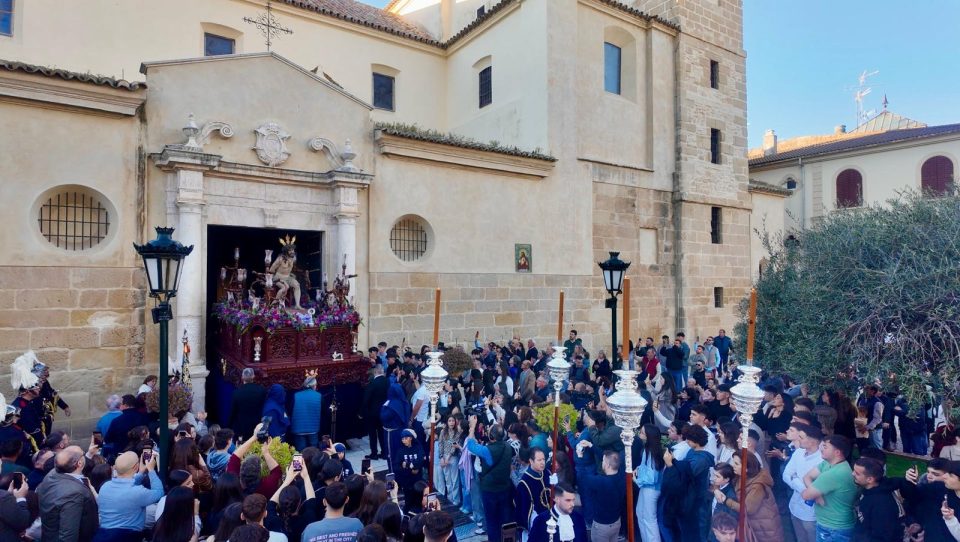
The Santísimo Cristo Ultrajado leaving the church of Santa María del Reposo.